Saturday, 21 September 2013

Chapter 9 : Enabling The Organization - Decision Making

DECISION MAKING
REASONS FOR GROWTH OF DECISION MAKING INFORMATION SYSTEM
  • People need to analyze large amounts of information – Improvements in technology itself, innovations in communication, and globalization have resulted in a dramatic increase in the alternatives and dimensions people need to consider when making a decision or appraising an opportunity.
  • People must make decisions quickly – Time is of the essence and people simply do not have time to sift through all the information manually.
  • People must apply sophisticated analysis techniques, such as modeling and forecasting, to  make good decisions – Information systems substantially reduce the time required to perform these sophisticated analysis techniques.
  •  People must protect the corporate asset of organizational information – Information systems offer the security required to ensure organizational information remains safe.
  • Model – A simplified representation or abstraction of reality

                                        IT SYSTEMS IN AN ENTERPRISE
                                   

TRANSACTION PROCESSING SYSTEM
  •  Moving up through the organizational pyramid users move from requiring transactional information to analytical information
                                     
  • Transaction processing system – the basic business system that serves the operational level (analysis) in an organization.
  • Online transaction processing (OLTP) – the capturing of transaction and event information using technology to (1) process the information according to defined business rules, (2) store the information, (3) update existing information to reflect the new information.
  • Online analytical processing (OLAP) – the manipulation of information to create business intelligence in support of strategic decision making

DECISION SUPPORT SYSTEMS
  • Decision support system (DSS) – models information to support managers and business professionals during the decision-making process.
  • Three quantitative models used by DSSs include;
1.       Sensitivity analysis – the study of the impact that changes in one (or more) parts of the model have on other parts of the model
2.       What-if analysis – checks the impact of a change in an assumption on the proposed solution
3.       Goal-seeking analysis – finds the inputs necessary to achieve a goal such as a desired level of outputs

                                                                      WHAT IF ANALYSIS


                                                                GOAL SEEKING ANALYSIS


EXECUTIVE INFORMATION SYSTEM
  • Executive information system (EIS) – A specialized DSS that supports senior level executives within the organization.
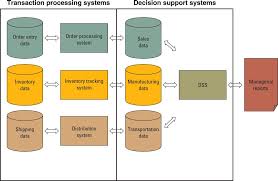
  • Interaction between a TPS and an EIS


  •  Interaction between a TPS and a DSS

  • Digital dashboard – integrates information from multiple components and presents it in a united display

ARTIFICIAL INTELLIGENCE (AI)
  • The ultimate goal of AI is the ability to build a system that can mimic human intelligence.
  • Intelligent system – various commercial applications of artificial intelligence.
  • Artificial intelligence (AI) – simulates human intelligence such as the ability to reason and learn.
  • Four most common categories of AI include;
1.    Expert system – computerized advisory programs that imitate the reasoning processes of experts in solving difficult problems
2.    Neural network – attempts to emulate the way the human brain works
o   Fuzzy logic – a mathematical method of handling imprecise or subjective information
3.    Genetic algorithm – an artificial intelligent system that mimics the evolutionary, survival-of-the-fittest process to generate increasingly better solutions to a problem
4.    Intelligent agent – special-purposed knowledge-based information system that accomplishes specific tasks on behalf of its users

DATA MINING
  • Data-mining software includes many forms of AI such as neutral networks and expert systems


Chapter 8: Accersing Organizational Information - Data Warehouse

Today I'm going to tell you about this chapter. As you can read at the above, this chapter is about assessing organization information by data warehouse. A data warehouse is a logical collection of information which is gathered from many different operational databases. It supports business analysis activities and decision making tasks. 


HISTORY OF DATA WAREHOUSING
•Data warehouses extend the transformation of data into information
•In the 1990's executives became less concerned with the day-to-day business operations and more concerned with overall business functions
•The data warehouse provided the ability to support decision making without disrupting the day-to-day operations
DATA WAREHOUSE FUNDAMENTALS
Figure 1
The primary purpose of a data warehouse is to aggregate information throughout an organization into a single repository for decision-making purposes. The informational can collected from internal or external database and before it transfer to data warehouse the information will enter through process extraction, transformation, and loading (ETL).
After that, it will send subsets of the information to data marts. When the information transfer to data warehouse, the ETL process will happen again to classify the information into the group or classes. For example, if the information from internal database is about marketing, so the information will go the same group that relates with marketing. It will not mess up with other information.

This is my understanding about data warehouse and how it operates.

Definition:
1.       Data warehouse: a logical collection of information - gathered from many different operational databases - that supports business analysis activities and decision-making tasks.
The purpose of data warehouse is to aggregate information throughout an organization into a single repository in such a way that employees can make decision and undertake business analysis activities.
2.       Extraction, transformation, and loading (ETL):  a process that extracts information form internal and external databases, transforms the information using a common set of enterprise definitions, and loads the information into a data warehouse. The data warehouse then sends subsets of the information to data marts.
3.      Date mart: contains a subset of data warehouse information.
To distinguish between data warehouse and data marts, thinks of data warehouse having a more organizational focus and data marts having focused information subsets particular to the needs of a given business unit such as finance/ production and operations.

MULTIDIMENSIONAL ANALYSIS AND DATA MINING
A relational database contains information in a series of two-dimensional tables. In a data warehouse and data mart, information is multidimensional where it contains layers of column and rows. Most data warehouse and data mart are Multidimensional Database.

Dimension : a particular attribute of information.

Cube: the common term for the representation of multidimensional information.

Figure 2
Ø  The figure 2 shows a cube (cube a) represents store information (the layers), product information (the rows) and promotion information (the column).
Ø  Once a cube of information is created, the users may begin to slice and dice the cube to drill down into the information.
Ø  Later, the second cube (cube b) displays slice representing promotion II information for all product, at all stores.
Ø  Third cube (cube c) which displays only information for promotion III, product B, at store 2.

Therefore, by using multidimensional analysis, users may analyze information in a number of different ways and with any number of different dimensional. For example, users can add dimensions of information to a current analysis including product category, region and even forecasted versus actual weather.

Data mining: process of analyzing data to extract information not offered by the raw data alone.
It also can begin at a summary information level and progress through increasing levels of detail (drilling down) or the reverse (drilling up). To perform data mining, users need data mining tools

Data mining tools: use a variety of techniques to find patterns and relationships in large volumes of information and infer rules from them that predict future behavior and guide decision making.
Date-mining tools for data warehouse and data mart include query tools, reporting tools, multidimensional analysis tools, statistical tools and intelligent agents.


INFORMATION CLEANSING OR SCRUBBING
An organization must maintain high-quality data in the data warehouse
Information cleansing or scrubbing: a process that weeds out and fixes or discards inconsistent, incorrect, or incomplete information.
It is where to increase the quality of organizational information and the effectiveness of decision making. Specialized software use sophisticated algorithms to parse, standardized, correct, match and consolidate data warehouse information.
Figure 3: Contact information in operational systems.
Figure 4: standardizing customer name from operational systems
Figure 5: information cleansing activities.
Figure 6: accurate and complete information.
Business Intelligence

Business intelligence (BI) refers to applications and technologies that are used to gather, provide access to, and analyze data and information to support decision-making efforts. It also information that people use to support their decision-making efforts
A certain school of thought draws parallels between the challenges in business and those of war, specifically:
     i.        Collecting information.
    ii.        Discerning patterns and meaning in the information.
  iii.        Responding to the resultant information.
ENABLING BUSINESS INTELLIGENCE

Principle BI enablers include
Technology : the most significant enabler of business intelligence.
People : Understanding the role of people in BI allows organizations to systematically create insight and turn these insights into actions.
Culture : A key responsibility of executives is to shape and manage corporate culture.

Chapter 7 : Storing Organizational Information


We are going to learn how and where all the information is stored. All the organizational information is stored in a database. But the information is stored based on the concept of database that has been collected. Mostly the information is a collection of records, or pieces of information. Typically, a given database has a structural description of the type of facts held in that database. This description called as a schema. The schema describes the objects that are represented in the database and the relationship among them.

RELATIONAL DATABASE FUNDAMENTALS

There are three models for organizing information in a database
  1. 1.     hierarchical models
  2. 2.    network models
  3. 3.    relational database models

From the transactional and analytical information, everything will be stored in database but the information will be store into its type itself. For example, if the information that been store is about marketing, so it will be group in marketing information in database.

Definition:
  1. 1.     Database: maintains information about various types of objects (inventory), events (transactions), people (employees), and places (warehouses)

  1. 2.    Hierarchical models: information is organized into a tree-like structure that allows repeating information using parent/child relationships in such a way that it cannot have too many relationships in such a way that it cannot have too many relationships. However, it cannot be used to relate to structures that exist in the real world.

  1. 3.    Network database model: flexible way of representing objects and their relationships. It is where it likes a tree of record with each record having one parent record and many children. Network model allows each record to have multiple parent and child record, forming a lattice structure

  1. 4.    Relational database model: types of database that more prevalent because stores information in the form of logically related two-dimensional tables. Good database can handle changes quickly and easily

ENTITIES AND ATTRIBUTES

ENTITIES: in the relational database model is a person, place, thing, transaction, or event about which information is stored. A table in the relational database model is a collection of similar entities.

ATTRIBUTES: is called fields or columns, are characteristics or properties of an entity class. The columns in each table contain the attributes

KEYS AND RELATIONSHIPS
To manage and organize various entity classes within the relational database model, developers must identify primary keys and foreign keys and use them to create logical relationships.
  1.  Primary keys: a field (or group of fields) that uniquely identifies a given entity in a table. It is important because they provide a way of distinguishing each entity in a table.
  2. Foreign key: in the relational database model is a primary key of one table that appears as an attribute in another table and acts to provide a logical relationship between the two tables.


RELATIONAL DATABASE ADVANTAGES:
  1. Increased flexibility
  2. Increased scalability and performance
  3. Reduced information redundancy
  4. Increased information integrity (quality)
  5. Increased information security
      i.        INCREASE FLEXIBILITY :
·         A well-designed database should handle changes quickly and easily, provide users with different views and have only one physical view
·         The distinction between logical and physical view is very important in understanding flexible database user views.
a.    Physical view: it deal with the physical storage of information on a storage device such as a hard disk.
b.    Logical view: focuses on how users logically access information to meet their particular business needs.
    ii.        INCREASED SCALABILITY AND PERFORMANCE
·   A database must scale to meet increased demand, while maintaining acceptable performance levels
·         Scalability: how well a system can adapt to increased demands
·         Performance: measure how quickly a system can adapt to increased demands
   iii.        REDUCED INFORMATION REDUNDANCY
·      Redundancy: the duplication of information or storing the same information in multiple places.
·         Inconsistency is one of the primary problems with redundant information.
·     Goal of database is to eliminate redundancy by put the information in one place in the database. Thus it can save space, perform the information easier and improve the quality.

   iv.        INCREASED INFORMATION INTEGRITY (QUALITY)
·         Information integrity: measures the quality of information
·     Integrity constraint: rules that help ensure the quality of information and built into a database design. It can be divided into two types:-
a.    Relational integrity constraint: rules that enforce basic and fundamental information based constraint.
b.    Business-critical integrity constraint: enforce business rules vital to an organization’s success and often require more insight and knowledge than relational integrity constraint.
     v.        INCREASED INFORMATION SECURITY
·         Information is an organizational asset and must be protected
·         Databases offer several security features including:
a)    Password: provides authentication of the user who is gaining and access to the system
b)    Access level: determines who has access to the different types of information
c)    Access control: determines types of user access, such as read-only access


DATABASE MANAGEMENT SYSTEMS

A database management system (DBMS) is software through which users and application programs interact with a database. It is where, the users send requests to the DBMS and the DBMS performs the actual manipulation of the information in the database. It can interact with two ways; directly or indirectly. DBMS is software for the users to access for communicate to get the information in database.

INTEGRATING INFORMATION AMONG MULTIPLE DATABASE
Ø  Integration: allows separate systems to communicate directly with each other.
Ø  Method of integration:
                      i.        Forward integration: takes information entered into a given system and sends it automatically to all downstream systems and processes
                    ii.        Backward integration: takes information entered into a given system and sends it automatically to all upstream systems and processes