Monday, 23 September 2013

Chapter 14 : E-Business

E BUSINESS
           
 The internet is a powerful channel that presents new opportunities for organization to;
§  Touch customers
§  Enrich products and services with information
§  Reduce costs

 How do ecommerce and ebusiness differ?
§  Ecommerce – the buying and selling of goods and services over the internet
§  E business – the conducting of business on the internet including, not only buying and selling, but also serving customers and collaborating with business partners


INDUSTRIES USING EBUSINESS


E BUSINESS MODELS

E business model – An approach to conducting electronic business on the Internet 


Business-to-Business (B2B)

  • Electronic marketplace (E market place) – interactive business communities providing a central market where multiple buyers and sellers can engage in e business activities. 


Business-to-Consumer (B2C)

  • Common B2C e business models include;
§  E shop – A version of retail store where customers can shop at any hour of the day without leaving their home or office
§  E mall – consists of a number of e shops; it serves as a gateway through which a visitor can access other e shops

Business types;
§  Brick-and-mortar business
§  Pure-play business
§  Click-and-mortar business


Consumer-to-Business (C2B)
  •   Priceline.com is an example of a C2B e business model.
  • The demand for C2B e business will increase over the next few years due to customer’s desire for greater convenience and lower prices


Consumer-to-Consumer (C2C)
  • Online auctions
§  Electronic auction (E auction) – Sellers and buyers solicit consecutive bids from each other and prices are determined dynamically
§  Forward auction – Sellers use as a selling channel to many buyers and the highest bid wins
§  Reverse auction – Buyers use to purchase a product or service, selecting the seller with the lowest bid.

 C2C communities include;
§  Communities of interest – People interact with each other on specific topics, such as golfing and stamps collecting
§  Communities of relations – People come together to share certain life experiences, such as cancer patients, senior citizens, and car enthusiasts
§  Communities of fantasy – People participate in imaginary environments, such as fantasy football teams and playing one-to-one with Michael Jordan


EBUSINESS BENEFITS AND CHALLENGES

E business benefits include;
§  Highly accessible
§  Increased customer loyalty
§  Improved information content
§  Increased convenience
§  Increased global reach
§  Decreased cost

E business challenges include;
§  Protecting consumers
§  Leveraging existing systems
§  Increased liability
§  Providing security
§  Adhering to taxation rules

There are numerous advantages and limitations in e business revenue models including;
§  Transaction fees
§  License fees
§  Subscription fees
§  Value-added fees
§  Advertising fees


MASHUPS

  • Web mash up – A Web site or Web application that uses content from more than one source to create a completely new services
§  Application programming interface (API) – A set of routines, protocols, and tools for building software applications
§  Mash up editor – WSYIWYGs (What You See Is What You Get) for mash ups

Saturday, 21 September 2013

Chapter 12: Integrating The Organization From End To End- Enterprise Resource Planning (ERP]

Enterprise Resource Planning (ERP)
The heart of an ERP system is a central database that collects information from and feeds information into all the ERP system’s individual application components (called modules), supporting diverse business function such as accounting, manufacturing, marketing, and human resources.


Figure 1: ERP integration data flow
v  ERP automates business processes such as order fulfillment- taking an order from a customer, shipping the purchase, and then billing for it.
Bringing the Organization Together


Figure 2: ERP Process Flow
·  ERP enables employees across the organization to share information across a single, centralized database.
·       With extended portal capabilities, an organization can also involve its suppliers and customers to participate in the workflow process, allowing ERP to penetrate the entire value chain, and help the organization achieve greater operational efficiency.


Figure 3: The Organization before ERP


The Evolution of ERP
Although ERP solutions were developed to deliver automation across multiple units of an organization, to help facilitate the manufacturing process and address issues such as raw materials, inventory, order entry, and distribution, ERP was unable to extend to other functional areas of the company such as sales, marketing, and shipping. It could not tie to any CRM capabilities that would allow organizations to capture customer-specific information, nor did it work with websites or portals used for customer service or order fulfillment.


Figure 4: ERP- Bringing the Organization Together


Figure 5: The Evolution of ERP
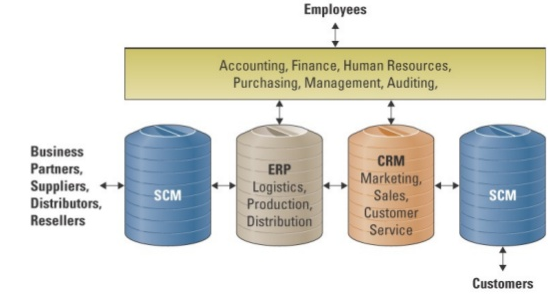
Integrating SCM, CRM, and ERP
SCM, CRM AND ERP are the backbone of e-business.
Integration of SCM, CRM, and ERP is the key to success for many companies.
Integration allows the unlocking of information to make it available to any user, anywhere, anytime.
2 main competitors in ERP market:
                      i.        Oracle
                    ii.        Sap


Figure 6: SCM market overview


Figure 7: Primary Users and Business Benefits of Strategic Initiatives.

Integration Tools
Ø  An integrated enterprise infuses support areas, such as finance and human resources, with a strong customer orientation.
Integration are achieved using:
Middleware: several different types of software that sit in the middle of and provide connectivity between two or more software applications. It translates information between disparate systems.
E.g.: If we want to download video from YouTube, so we need to have YouTube downloader. Thus, YouTube downloader is the middleware as to download the video.
Enterprise application integration (EAI) middleware: Represents a new approach to middleware by packaging together commonly used functionality, such as providing prebuilt links to popular enterprise applications, which reduces the time necessary to develop solutions that integrate(combine) applications from multiple vendors.
Figure 8: Integration between SCM, CRM and ERP application
Enterprise Resource Planning’s Explosive Growth

Reasons of ERP being proven to be such a powerful force:

      i.        ERP is a logical solution to the mess of incompatible applications that had sprung up in most businesses.

    ii.              ERP addresses the need for global information sharing and reporting.

   iii.             ERP is used to avoid the pain and expense of fixing legacy systems

To qualify as a true ERP solution, the system not only must integrate various organization processes, but also must be:

*  Flexible: an ERP system should be flexible in order to respond to the changing needs of an enterprise.
*     Modular and open: an ERP system has to have open system architecture, meaning that any module can be interfaced with or detached whenever required without affecting the other modules. The system should support multiple hardware platforms for organizations that have a heterogeneous collection of systems. It must also support third- party add-on components.
* Comprehensive: an ERP system should be able to support a variety of organizational functions and must be suitable for a wide range of business organizations.
*  Beyond the company: an ERP system must not be confined to organizational boundaries but rather support online connectivity to business partners or customers.

v  Everyone involved in sourcing, producing, delivering the company’s product works with the same information, which eliminates redundancies, cuts wasted time, and removes misinformation.


ERP solution are growing because:
§      ERP is a logical solution to the mess of incompatible applications that had sprung up in most businesses.
§        ERP addresses the need for global information sharing and reporting.

§       ERP is used to avoid the pain and expenses of fixing legacy systems.